An AI voice agent can call 500 customers before lunch to remind them about appointments. It can also get your phone lines cut off, if you set it up as though the rules had not changed.
On 18 September 2026, the Telecom Regulatory Authority of India (TRAI) issued the Third Amendment to its commercial communication rules, the TCCCPR. The rules now define automated calls, and they put a duty on every business that makes them.
We build a voice agent, Vaat AI, so we read the regulation itself rather than the headlines. Here is what it says. This is not legal advice, so check your own case with your operator or counsel.
What counts as an automated call
The regulation calls them Application-to-Person (A2P) calls: a voice call "initiated by an application, software system, or automated platform without direct human dialling", including autodialling, robo-calls and pre-recorded or artificial voice.
If your AI agent dials out, that describes it.
Two things businesses may hope will exempt them do not:
- "A person joins the call." Stakeholders asked TRAI to leave out calls with a live agent. TRAI declined, saying operators cannot technically tell which calls have a human on them.
- "It is only a reminder, not marketing." TRAI says the regulations "apply to all A2P calls", because a narrower rule could be misused to pass off spam as service calls.
It was also asked to exclude AI-enabled calls and callbacks that customers had requested. The final regulation contains no such exception.
What about AI that answers calls?
The definition is about calls that software initiates. When a customer dials you and an AI agent picks up, the customer started the call. Our reading is that answering is not A2P calling, so an AI receptionist on your incoming line is not what this rule targets.
It matters, because most businesses that want a voice agent want it for exactly that: after hours, on Sundays, and when three people ring at once. It is the simpler place to start. (How customers should be told they are talking to AI is a separate question, which we covered for the EU's rules.)
But watch the edges. If the agent calls back a missed caller by itself, that is an outgoing automated call.
The main duty: declare it first
Every sender must tell its operator, in advance, that it uses A2P calls, and give the number ranges (CLIs) it will call from. The operator records this on the DLT platform.
Miss that step and the call is treated as unsolicited commercial communication. In plain words, spam, even if the person on the other end is your own customer.
This part comes into force 60 days after the regulation was published in the Official Gazette; most of the rest takes 30 days and some parts 90. Counted from 18 September, 60 days ended around 17 November 2026. We could not confirm the exact Gazette date, so treat the duty as live and confirm with your operator.
Which number to call from
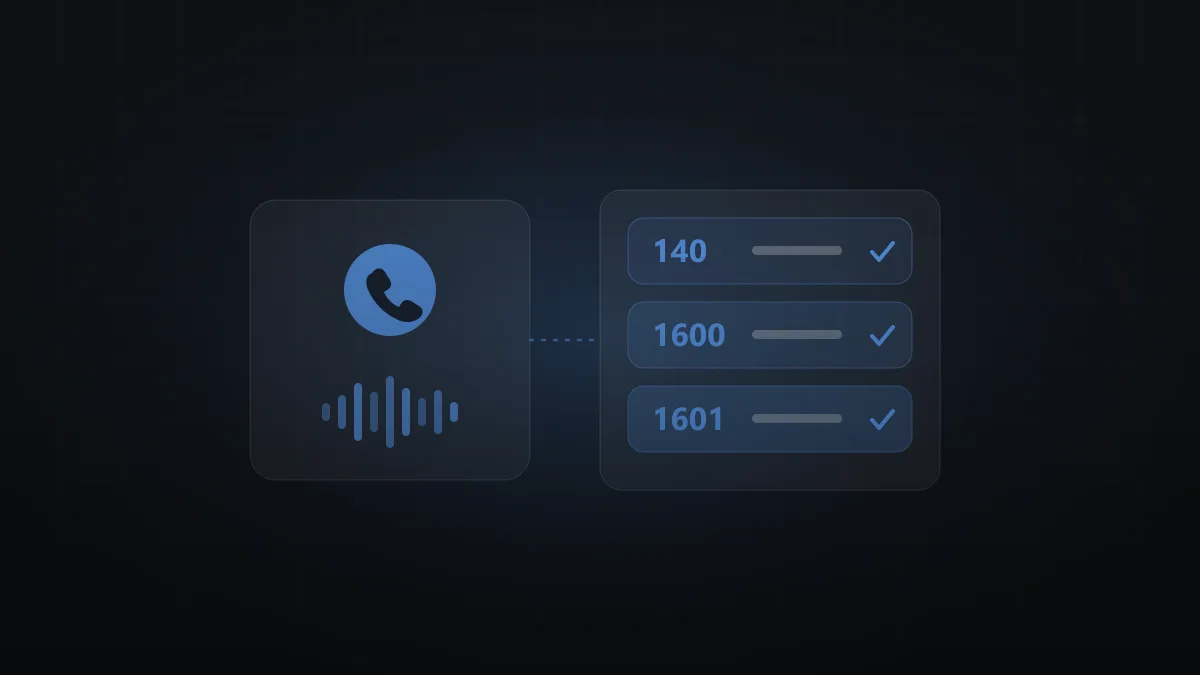
| Purpose | Series | Who it is for |
|---|---|---|
| Promotional calls | 140 | Registered senders and telemarketers |
| Service and transactional | 1600 | Banking, financial services, insurance, and government |
| Service and transactional | 1601 | Other sectors, being opened in phases |
The first phase of 1601 covers utilities, logistics and courier companies, under a TRAI direction of 10 August 2026. If you run a clinic, a school or a real estate firm, ask your operator what is open to you today.
The special series come with real benefits. Operators must not flag them as suspected spam, call-blocking apps may not block or tag them wholesale, and they are exempt from a new charge of up to 5 paise a minute that operators can levy on each other for automated calls.
Promotional calls from a service number are a serious violation, so keep the two apart.