
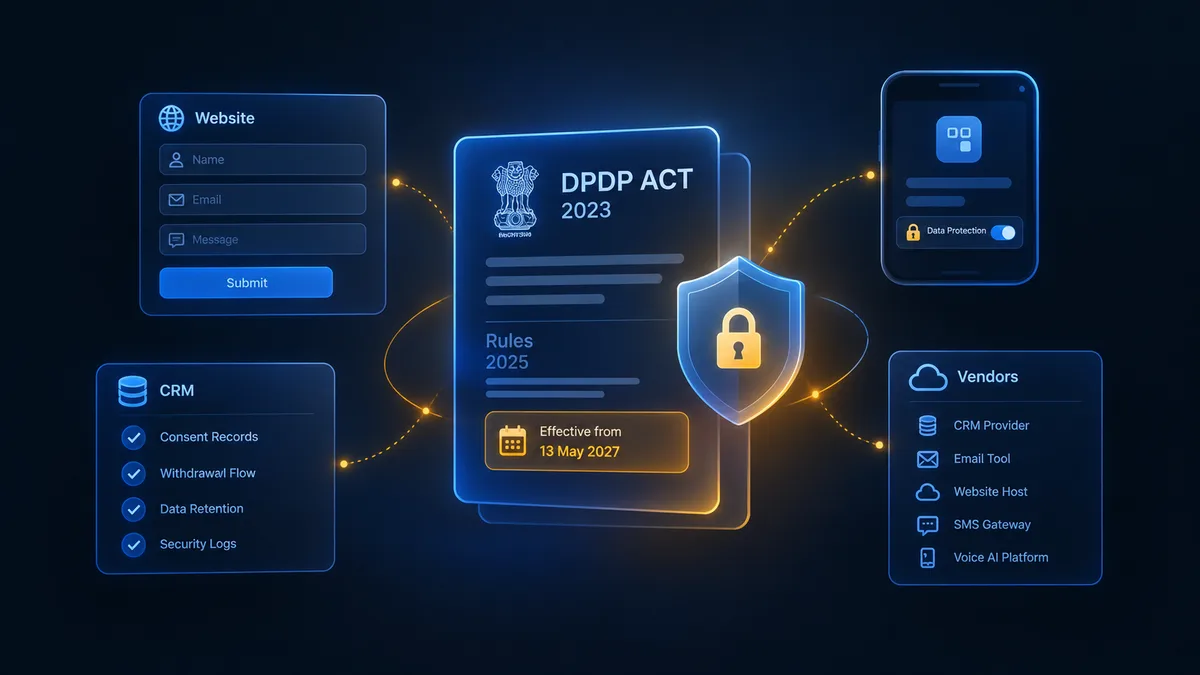
13 May 2027 is a little over six months away. Most Indian businesses know a data protection law exists. Far fewer have opened their own contact form lately to see what it collects, and why.
This is a practical read of the Digital Personal Data Protection Act, 2023 and the DPDP Rules, 2025 for people who run websites, CRMs and apps. We build those things for a living, so that is the angle. We are not a law firm and nothing here is legal advice, so have your counsel read the Rules for your sector.
The dates
The Rules were notified on 13 November 2025 and published in the Gazette the next day. A few provisions started straight away, mainly the ones that set up the Data Protection Board. The duties that touch everyday business (notice, security safeguards, breach reporting, retention, children’s data and the rights people can exercise) come into force on 13 May 2027. The rules on consent managers arrive earlier, this November, and most businesses won’t deal with those directly.
Penalties are caps, not fixed amounts: up to ₹250 crore for failing to keep reasonable security safeguards and up to ₹200 crore for failing to report a breach. The Board is meant to weigh severity, duration, the kind of data involved and how you responded. Nobody knows yet how hard it will enforce in its first year, and we wouldn’t build a plan around finding out.
Your website
Open your contact form and count the fields. For each one, ask whether you need it to answer the message. The law ties consent to the data that is necessary for the stated purpose, so a “Contact us” form that also asks for date of birth, full address and company size is hard to defend.
Then the notice. At or before the point of collection, people need a plain-language notice that says what you collect, what you use it for, how to withdraw consent, how to exercise their rights and how to complain to the Board. The Act says it should be available in English or any of the 22 languages in the Eighth Schedule. A Gujarati or Hindi version of your notice is a real option and, for plenty of audiences, a better one.
Consent boxes need work too. No pre-ticked boxes. One purpose per consent, so “I agree to be contacted about my enquiry” and “send me your newsletter” are two separate things. Withdrawing has to be as easy as agreeing, which rules out a form that takes one click to join and an email to a support address to leave.
Then the trackers. The Act doesn’t mention cookies by name, but a pixel that ties a visit to an identifiable person is processing personal data, and for marketing that usually means you need consent first. List every script on your site: analytics, Meta Pixel, heatmaps, chat widgets, embedded forms. Decide which ones really need to be there. Whatever stays should load only after consent wherever consent is your basis.
Finally, publish a contact point, a person’s name or title and an email address, for people who have questions about their data.
Your CRM
Export the last 500 rows and read the column headers out loud. For each one, can you say what it is for? Anything with no answer is a candidate for deletion.
After that, three things usually need rebuilding.
Consent records. A tick in a form isn’t a record. You want to be able to show who agreed, when, to which version of the notice, for which purpose and through which channel. Add those as fields and fill them automatically at capture.
Withdrawal that travels. If someone withdraws on the website, that has to reach your email tool, your WhatsApp broadcast list, your ad audiences and the spreadsheet a sales rep keeps on the side. This is where most setups break, and it is an automation job more than a legal one.
Retention. Decide how long a cold lead is worth keeping and delete on a schedule instead of by good intentions. Separately, the Rules expect security logs and related data to be kept for at least a year, so retention isn’t only about deleting.
On security more broadly, the Rules name the safeguards: encryption or masking, access control, logging and monitoring, and backups. In practice that means no shared logins, two-factor on anything holding customer data, role-based access, and a sales team that can’t export the whole database with one button.